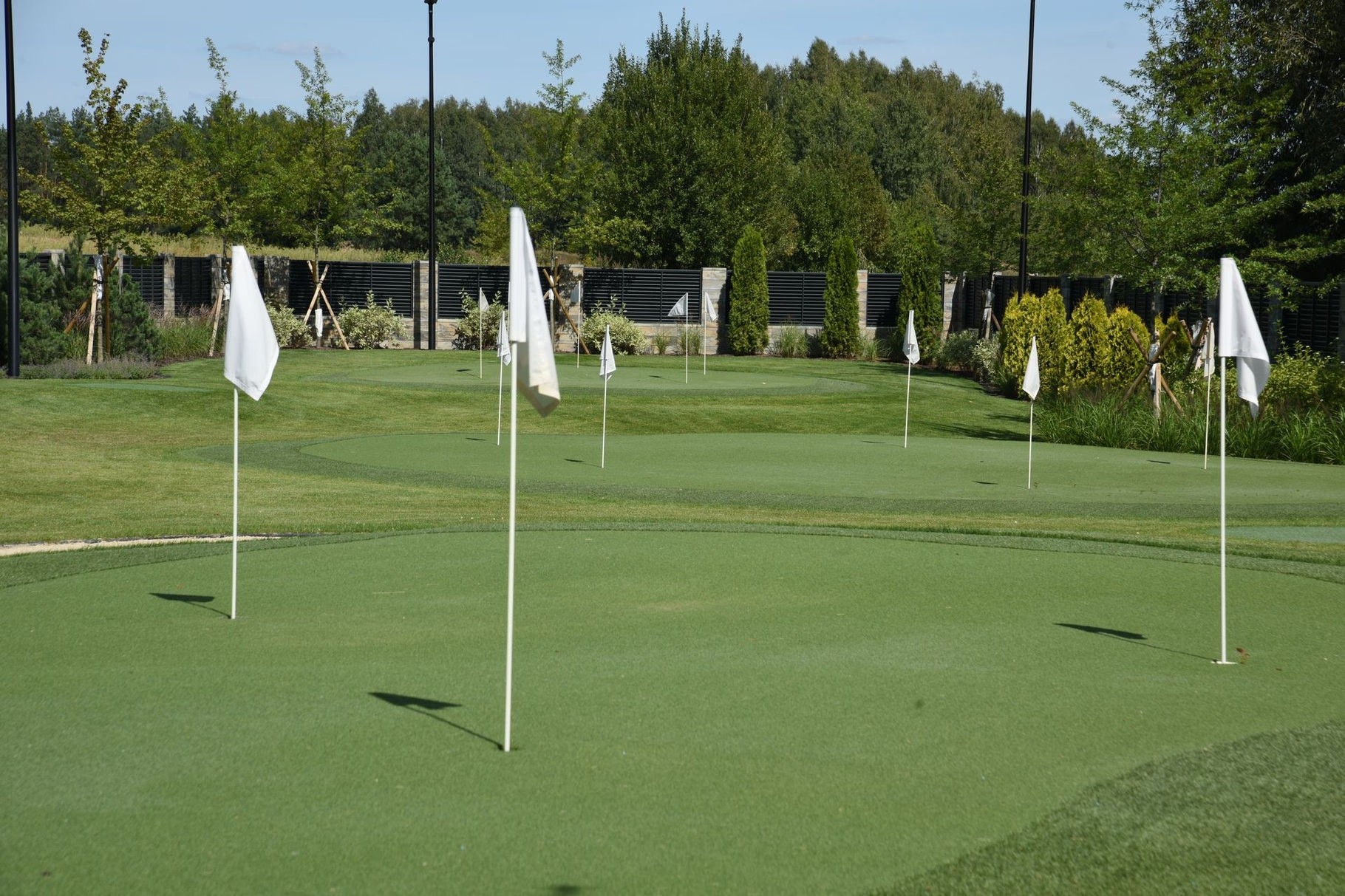
Putting green in the garden – a guide to professional golf surfaces. Why does synthetic win over nature?
Executive Summary for the Investor
The dream of having your own "Augusta National" in the garden often collides with the harsh reality of maintenance costs. Our economic and practical analysis shows an overwhelming advantage of modern synthetic systems over natural grass in residential conditions.
ROI (Return on Investment): The break-even point for synthetic turf comes as early as year 2–3 of use.
Maintenance costs: A natural green generates annual costs of around PLN 25,000–80,000 (labor, chemicals, water). Synthetic turf is only a fraction of that amount.
Play time: On synthetic grass, you play 365 days a year. Natural grass requires regeneration, aeration, and is susceptible to diseases (Dollar Spot, Brown Patch).
The choice is simple: either you become a full-time gardener, or a golfer who simply steps into the garden and plays.
Natural Grass – Beautiful but a Demanding "Prima Donna"
Many investors assume that sowing a professional variety like Bentgrass (creeping bentgrass) or Bermuda will solve everything. That is a mistake. Golf grasses are organisms bred for extreme conditions, and they require extreme care.
The reality of owning a natural green:
Mowing: Not once a week, but 3–6 times per week with a specialized reel mower (the machine alone costs approx. PLN 4,000–20,000)[2].
Chemicals: Regular fertilization, fungicides (against fungi), and insecticides. Without this, the green will "fall ill" within a few days[2].
Water: Daily, precise irrigation. One system error and the grass either dries out or develops mold.
10-year cost: Maintaining a natural green of approx. 30 m² for a decade may cost up to PLN 650,000 (including professional greenkeeper labor, water, and materials)[3][4].
The Synthetic Alternative – Engineering in Service of Golf
Modern synthetic grasses are not "green carpeting" from a DIY store. They are advanced sports turf systems with completely different durability and performance parameters.
The key difference lies in fiber behavior. These turfs are designed to withstand high friction generated during club strikes (divots). What is more, compressed fiber is elastic enough to recover over time and return upright—unlike cheaper decorative turfs, where individual fibers are very easy to break or permanently deform.
At Golf Masters, we design installations to faithfully replicate full golf physics:
Proper shock absorption level (depending on training needs).
Ball bounce—realistic behavior on the "first bounce" after an approach shot.
True Roll—predictable ball roll on the green.
How do we do it at Golf Masters?
We do not use just one type of turf. Our installations are hybrid systems, selected by function:
Green: Dense, short fiber that provides ideal smoothness after quartz sand infill.
Fringe (collar) / Fairway: Longer grass around the green, allowing chipping practice.
Tee Box: Reinforced surface into which you can insert a tee and hit a full swing without damaging the base.
Technical Parameters – What Determines Playing Quality?
When choosing a green, you need to know these four concepts. They are what separate a toy from a professional training facility.
Shock Absorption:
This parameter determines how the green "receives" a ball struck from distance (pitching/chipping). We regulate it by the amount of quartz sand infill in the turf. This follows directly from pile height—higher fiber allows more sand infill, increasing absorption so the ball lands softly instead of bouncing like off concrete.Stimp Rating (Speed):
Measures how fast the ball rolls.6–8: Slow (typical lawn).
9–11: Golf Masters Standard—the ideal balance, matching most good golf courses.
12+: Tournament speed (PGA Tour). Achievable, but very difficult for amateurs. Thanks to sand quantity adjustment, we can adapt green speed to your preferences[5].
Face Weight (Density):
The higher the pile weight (e.g., 50–70 oz/yd²), the more durable and resilient the turf. This prevents worn "paths" in spots where you stand most often.Pile Height:
For greens, we use fibers approx. 13–16 mm high (1/2 inch). After sand infill, the fiber tips protrude minimally, creating an ideal rolling surface where the ball does not hop[6].
Golf Masters Installation Process – Why Is "DIY" a Bad Idea?
Laying the turf is the last and easiest stage. 80% of success is what happens underneath. DIY installation usually ends with unevenness that disqualifies the green from use after a year.
Our process (Green-Mapping):
Earthworks and drainage: We shape the terrain (shape), creating a load-bearing aggregate base that drains water away. The green must be dry shortly after rain.
Break design: This is not a flat table. We design slopes and undulations in percentages so you can practice difficult "left-to-right" putts using the properties of turf and sand.
Installation and sand infill: This is a surgical stage. The sand must be dry and applied in layers. It is what "sets" the final speed and shock absorption of the green.
Tuning: After installation, we check ball roll and correct any imperfections.
We also provide you with a complete "Toolbox": a roller and a special brush, plus instructions on how to care for the green so it serves you for many years. We also offer service visits to "fine-tune" the already installed surface over time.
Economics: When Will It Pay Off?
Let’s compare estimated costs for a green of approx. 30 m² over a 10-year period[7].
Green Type | Installation Cost (Year 0) | Maintenance Cost (10 years) | TOTAL (10 years) |
Natural | ~PLN 25,000 | ~PLN 550,000–750,000 | ~PLN 600,000+ |
Synthetic | ~PLN 25,000–40,000 | ~PLN 20,000–40,000 | ~PLN 60,000–80,000 |
Savings after a decade: over PLN 500,000. Not including your time, stress, and water consumption. Additionally, a professional green increases property value by approx. 5–10%[8].
Who Is This Solution For?
A professional putting green in your garden is the solution for you if:
You want to realistically lower your handicap by training 15–20 minutes daily (instead of once a week).
You value low maintenance—you want to play, not mow.
You are looking for an aesthetic, year-round garden architecture feature that impresses guests and business partners.
Your garden can be better than the local Driving Range.
Contact us to schedule an on-site consultation. We will help you design a short game area that transforms your garden into a private golf academy.
[Request a free quote for your garden]
References:
[1] LawnPop: Benefits of Synthetic Golf Putting Green
[2] Purchase Green: Backyard Putting Green Cost
[3] USGA: How to make your backyard putting green dream a reality
[4] Homes.com: Cost of Backyard Putting Green
[5] Turf Network: Best Putting Green Turf & Stimp Ratings
[6] Flooring Inc: The Best Putting Green Turf
[7] Lawn Kings Inc: ROI Artificial Turf
[8] HomeAdvisor: ROI Data

Level up your game
Let's meet
Design office:
1 Górnośląska St.,
00-443 Warsaw
Showroom:
Golf green - book an appointment
Chabrowa 2 St.,
62-053 Borkowice
Write
Email address