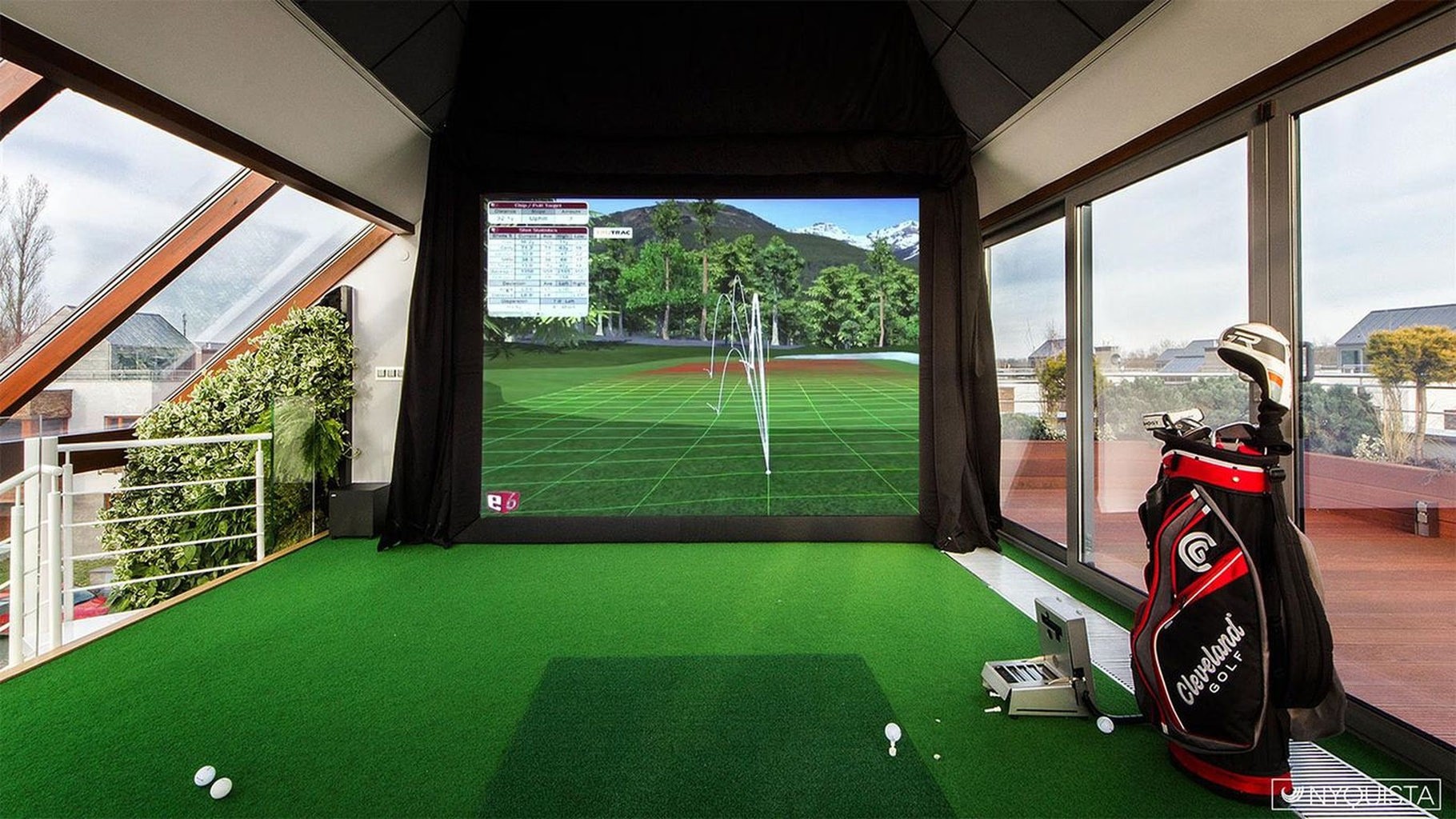
Golf swing analysis – why recording with a phone is not enough?
Scientific verdict: This is not marketing, it’s engineering
The thesis is simple and scientifically confirmed: standard phone recording is not suitable for professional swing analysis.
Why? Because golf is a sport of milliseconds. A clubhead moving at 100 mph (approx. 160 km/h) covers huge distances within a single frame of standard video. Studies from institutes such as Cal Poly, NIH, and IEEE show that dedicated systems (simulators) outperform smartphones in every key parameter:
Temporal resolution: Simulators are 6–17 times faster at image capture.
Angular precision: Measurement error in a simulator is only ~2°, while in mobile apps it reaches nearly 7°.
Latency: A simulator processes data in a fraction of a second, providing immediate feedback.
If you want to fix an error, you first have to see it. A phone often shows you a distorted picture of reality.
Math doesn’t lie: Where do the frames disappear?
Understanding the problem requires simple math. Let’s assume a club speed of 100 mph (typical amateur/pro). In one second, the clubhead travels about 45 meters.
Here is how much distance the camera “loses” between each frame [1]:
Phone (30 fps): The club moves by ~152 cm (60 inches) between frames. That’s a chasm.
Phone (240 fps - SloMo mode): The club moves by ~19 cm. Better, but still inaccurate.
Simulator camera (500+ fps): The club moves by only 0.7–9 cm.
What does this mean in practice? The impact zone lasts only a few milliseconds. Recording on a phone at 30 or 60 frames per second, the moment of club-ball contact often falls “between” frames. You see the club before the ball, and then already after impact. You can’t see whether you struck the center or opened the clubface. It’s like trying to analyze a car crash based on two photos: before and after the collision.
What do the latest studies (2025) say?
In recent years, science has taken a close look at the differences between amateur video and professional biometrics.
Artificial intelligence blind spot (Cal Poly & Carnegie Mellon, 2025): Researchers tested popular mobile apps that use AI to draw lines on a golfer’s body. Result? The average measurement error was as high as 6.8° in the front view. For comparison—so that analysis is useful for coaching, the error must stay within ±2-3°. A phone simply is not precise enough [2].
The industry standard is 200 FPS (NIH 2022): A review of over 90 scientific papers in golf biomechanics established that the minimum value for reliable studies is 200 frames per second. Only 10% of studies allowed lower values. Your phone in standard video mode does not even meet the minimum scientific requirements [3].
Motion flow vs. static positions (IEEE 2025): Cameras in simulators analyze “motion flow” (motion flow), not just individual photos. Thanks to this, these systems achieve over 25% higher effectiveness in distinguishing subtle technical errors than the best smartphone algorithms (e.g., MediaPipe) [4].
Why does a simulator see more? The technological advantage
At Golf Masters, we focus on engineering, not half measures. Professional simulators (such as those based on TrackMan or Foresight) have three key advantages over a smartphone that are rarely discussed:
1. Global Shutter
Most phones use so-called Rolling Shutter—the image is recorded line by line. With fast club movement, this causes distortion (the club looks bent like a banana). Cameras in simulators use Global Shutter—they capture the entire image at one instant, eliminating inaccuracies [5].
2. Multi-channel synchronization (Multi-view)
A phone sees you from only one perspective (2D). A simulator uses several cameras at the same time (side, top, rear), creating a three-dimensional swing model. Thanks to this, the system doesn’t have to “guess” image depth—it sees it.
3. Data fusion: Video + Radar
This is the most important point. A phone only sees your body. A simulator integrates video with Doppler radar data. This means the system knows not only what your movement looked like, but also what its effect was: ball spin, angle of attack (Angle of Attack), and clubhead speed. It’s a complete picture of impact physics [6].
Conclusions for the player: When to use a phone, and when a simulator?
Does this mean you should throw away your phone? Absolutely not. A smartphone is a great tool for a quick preview, e.g., checking swing tempo or general posture on the driving range. However, for diagnosing problems, correcting technique, and impact analysis—it is insufficient.
If you’re serious about improving your game:
Home practice: Use your phone in Slow-Motion mode (240 fps), but be aware of its limitations (blur, lack of angular precision).
Error analysis: Use a simulator. Only there will you get feedback with the precision that allows you to realistically correct club positioning by the crucial 1–2 degrees.
Remember: In golf, what you think you’re doing (feel) is rarely what you’re actually doing (real). Only high-speed cameras and radar will show you the truth.
Want to see your swing at 500 frames per second? Visit the Golf Masters Showroom. Test the technologies used by top PGA Tour players and see the difference between “recording” and “analyzing.”
[Book a professional swing analysis]
References:
TPI: Measuring the Timing of the Golf Swing from Video
Cal Poly/CMU: An Intelligent Mobile System for Personalized Golf Swing Analysis (2025)
NIH: Golf Swing Biomechanics: A Systematic Review (2022)
IEEE/NIH: Dynamic Golf Swing Analysis Framework (2025)
e-con Systems: The Role of Golf Swing Analysis Cameras (2024)
Golf Swing Systems: How Does a Golf Simulator Work? (2025)



Level up your game
Let's meet
Design office:
1 Górnośląska St.,
00-443 Warsaw
Showroom:
Golf green - book an appointment
Chabrowa 2 St.,
62-053 Borkowice
Write
Email address