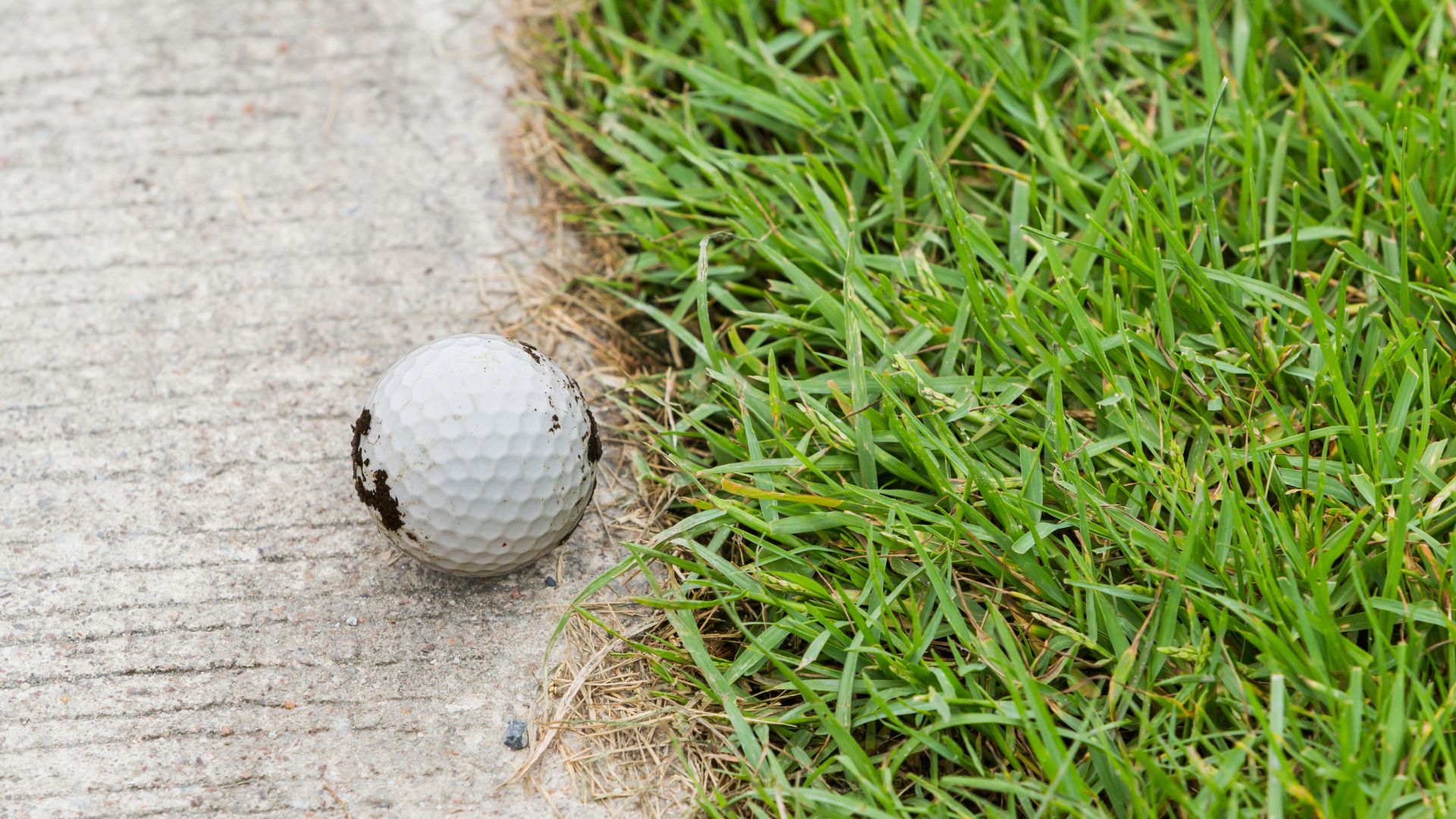
Dropping the ball in golf - rules, penalty areas, and the most common player mistakes
Ball Release Rules (relief) are among the most commonly misunderstood rules in golf. This article is your engineering cheat sheet. We will organize the procedures, separate free relief from penalty areas, and point out the most common mistakes. You will also learn how modern simulator technology can lighten your mind and teach you these complicated rules in practice.
When do you need to drop the ball?
To avoid confusion on the course, it's worth building a simple mental model based on two categories. The dropping procedure is initiated when you take free relief (free relief) or penalty relief (penalty relief).
Free relief concerns random situations and technical obstacles on the course. You drop the ball when it lies on a concrete cart path, falls into an area under repair (Ground Under Repair), is in temporary water (e.g., a large puddle after a rain), or when it is embedded in its own track in the general area of the course.
On the other hand, penalty relief involves scenarios where you save yourself from a difficult situation at the cost of an additional stroke. This includes instances where the ball lands in a red or yellow penalty area, you deem it unplayable in dense bushes, or when you must play from the previous location after your ball was lost after a long drive (stroke and distance procedure).
Key Decision-Making Principle:
If you can and want to play the ball from where it lies – you do not have to drop it. If the rules require changing its position or you make such a rescue decision, you enter the strict dropping procedure.
How to properly drop the ball – technical "how‑to"
Dropping the ball is a strict, technical procedure, allowing no room for improvisation. The first rule is that the player must drop the ball themselves (in team formats, this can be done by the player whose ball is in play or their partner). Then, precision of execution is important.
The ball must be dropped vertically, exactly from knee height, while standing straight. It must not be thrown, spun, or dropped from shoulder or ankle height. It is also critical where the ball hits the ground and where it finally comes to rest. The first contact with the ground must occur strictly within the designated relief area or exactly on the designated line (in the case of the back-on-the-line option).
The drop is considered successful when the ball has been dropped according to the rules and comes to rest within the relief area. If after a correct drop the ball rolls out of the area, a second drop must be made. If the situation repeats, the ball must be placed exactly where it hit the ground on the second drop in the relief area.
Step | What the player does | What is technically important |
1 | Chooses the type of relief | Determining whether it is free vs penalty, option 1 or 2 club lengths, or back-on-the-line. |
2 | Designates the reference point | Nearest point of relief / crossing point of the boundary / original ball location. |
3 | Measures the relief area | 1 or 2 club-lengths, keeping in mind the rule of "not closer to the hole". |
4 | Drops from knee in the area | Vertical drop, no throwing, no spinning. |
5 | Checks where the ball has come to rest | Resting in the area = ball in play. Rolling out = second drop or “place”. |
Penalty Areas – Red, Yellow, and What to Do With Them
Former “water hazards” are now simply penalty areas. They include not only ponds or rivers but also marked bushes, ditches, or dense forests. Understanding the color of the stakes is key to choosing the right rescue path.
Yellow penalty area (standard penalty area) gives you two options after adding one penalty stroke. You can return to the location of the previous stroke (stroke & distance) or take the option of relief on the line (back-on-the-line). In the latter case, you designate a straight line from the hole, through the point where the ball crossed the boundary of the area, and you move back along this line as far as you wish before dropping the ball.
Red penalty area (lateral penalty area) gives you all the options of the yellow area but adds one crucial third option – lateral relief. You can designate a dropping area within two club lengths from the point where the ball last crossed the red line (of course not closer to the hole).
Area Color | Options after adding 1 penalty stroke |
Yellow | Stroke & distance; Back-on-the-line |
Red | Stroke & distance; Back-on-the-line; Lateral relief (up to 2 club lengths) |
It is worth remembering that if you deem the ball unplayable outside the penalty area, you have three similar options: stroke & distance, back-on-the-line, and lateral relief within two club lengths from the ball's resting place. The exception is the bunker – the same rules apply for 1 penalty stroke (but the ball must remain in the sand), with the additional option of going outside the bunker on the line back for 2 penalty strokes.
Free Relief – When Do You Drop Without Penalty?
Free relief is a purely technical operation designed to protect the player from hitting from concrete or areas unplayable through no fault of their own. The most common cases are hard paths (cart path), marked ground under repair (GUR), or temporary water.
The foundation of free relief is finding the so-called nearest point of complete relief (Nearest Point of Complete Relief - NPR). It is the closest spot from the ball's current position, not closer to the hole, where neither the ball nor your stance (foot position), nor the swing space is interfered with by the given object. From that precise point, you designate a zone of one club-length and drop from the knee there.
This is precisely where players face the greatest mental trap. The nearest point of relief is a strictly geometric concept – it does not mean a location that is “best for your score”. Sometimes the mathematically nearest point of relief from a path is in dense rough or behind a tree trunk. In such a situation, you must decide: whether to play from the hard path or accept the free relief that paradoxically worsens your position.
Common Mistakes Players Make When Dropping
Lack of knowledge combined with time pressure on the course leads to repeated mistakes. Most of them incur penalties added to the score (most often for playing from the wrong spot).
Dropping from the shoulder, not from the knee – habits from before the rule changes in 2019 are still alive. Dropping the ball from shoulder height is an incorrect drop.
Estimating the area “by sight” – lack of precise determination of the reference point and not imposing a discipline of measuring 1 or 2 club lengths often ends in a drop outside the allowed area.
Taking free relief from the wrong place – for example, attempting to take free relief from a concrete path while the designated nearest point of relief falls within the red penalty area. Free relief does not apply in the penalty area.
Confusing back-on-the-line with lateral relief – players often move back on the line to the hole but instead of dropping on that axis, they go two clubs to the side “where the grass is nicer”.
Lack of the “place” procedure – the ball rolls out of the relief area twice after the drop, and the player persistently drops it a third time instead of placing it where it hit the ground the second time.
Test dropping – intentionally dropping the ball to check “if the grass is hard and if the ball will roll” is a serious violation of the spirit of the game.
Stopping a falling ball – attempting to catch the ball in the air or block it with your foot to “prevent it from escaping the area”.
Checklist for a Correct Drop (to ask yourself mentally on the course):
Do I know for sure whether I am taking penalty relief or free relief?
Have I correctly designated the reference point?
Have I physically or mentally measured the exact area of 1-2 club lengths?
Did I drop from the knee and ensure the ball stayed within the designated area?
How to Learn to Drop “Without Stress” - The Role of the Simulator
On a real golf course, pressure operates. The pace of play is set, with another flight pushing from behind, and your partners are waiting to hit. In such conditions, few have the time, courage, and calmness to pull out the rule book, slowly measure club lengths, and analyze geometric options for relief. Mistakes arise from haste.
It looks entirely different in home conditions or in a professional indoor area. Playing on a golf simulator, you gain time and absolute calm to practice each difficult scenario coolly. Moreover, you are not left to your own devices.
Advanced software of the simulator acts like a virtual, flawless referee. When your digital ball lands in a virtual lake or bushes, the system automatically stops the game and displays available options. The software precisely marks the relief area on the screen, calculates the distances of 1-2 clubs, and visualizes the difference between playing from the line back and lateral relief. You learn to make decisions in practice without the risk of penalties on the scorecard.
The result? You build excellent decision-making habits and spatial visual memory. When you return to a real course after winter and your ball lands near a red stake, your mind will immediately sketch the correct area on the grass. You will know precisely what to do and how to do it, drawing from the knowledge gained before the screen.
A complicated rule that is easy to practice virtually. The simulator software automatically indicates the dropping location, teaching you along the way.



Level up your game
Let's meet
Design office:
1 Górnośląska St.,
00-443 Warsaw
Showroom:
Golf green - book an appointment
Chabrowa 2 St.,
62-053 Borkowice
Write
Email address