Drainage and the sub-base of the putting green - why are they more important than the grass itself?
Why is this happening? Because the grass is just 1 centimeter of the problem.
Most golfers and investors evaluate greens based on their surface, forgetting that true engineering lies 20 - 40 cm below the ground. How a green accepts the ball, how quickly it drains water, and how it withstands loads is determined by drainage and the subgrade. When you buy a professional green, you are not buying a "smooth roll" - you are buying an advanced hydro-technical structure. Understanding this mechanism is the first step to a successful investment.
How is a modern putting green built? (Cross section according to USGA)
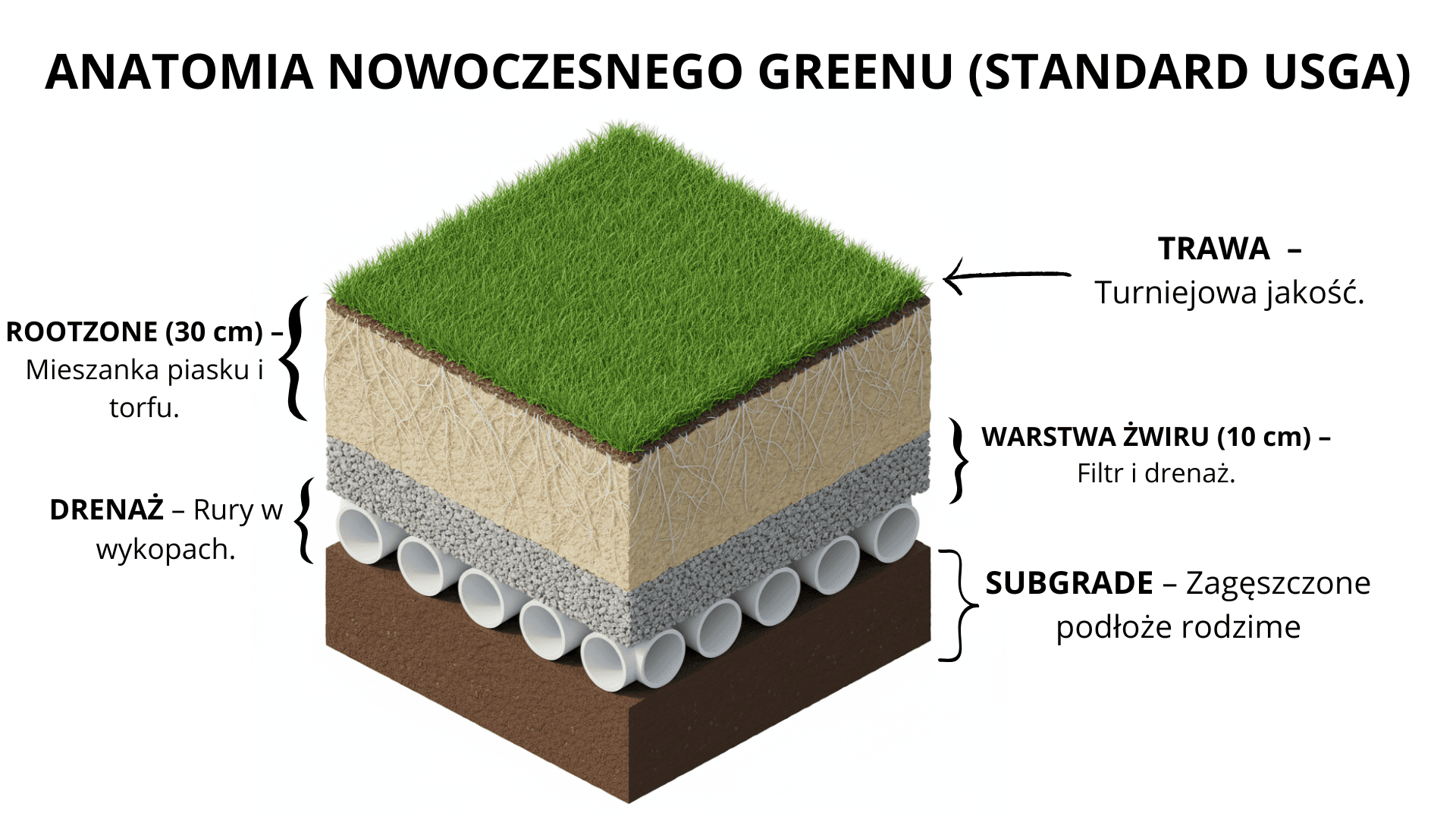
To understand why a green functions correctly, one must look at it as a civil engineer. The standard determining quality worldwide is the USGA guidelines (United States Golf Association). According to them, a modern green is a multilayered structure:
Subgrade
This is the foundation formed from local soil. It must be compacted properly to avoid settling but not concreted. Importantly, the slope of this layer should accurately reflect the target slope of the finished green's surface, instead of creating its own, independent depressions or grooves. With such shaping, water infiltrating from higher layers moves evenly and predictably.Subsurface drainage system
A network of pipes laid in trenches cut into the subgrade layer. Main lines and lateral pipes are laid approximately every 4–5 meters with a minimum slope of 0.5%. A crucial element is also the perimeter drain (at the lowest edges), which absolutely prevents the formation of underground "pools" at the base of the green.Gravel layer
According to USGA guidelines, this layer is typically about 10 cm thick, usually ranging from 10–15 cm, composed of rigorously selected gravel. It serves two functions: first, it acts as a filter protecting the drainage pipes from siltation. Second (and more importantly), the physics of this layer creates the phenomenon of the so-called perched water table (described below). Since the update of standards in 2018, USGA has placed great emphasis on precise grain size and neutral pH of the gravel, which prevents the sedimentation of deposits.Rootzone
This is the layer where roots develop (usually about 30 cm thick). It is absolutely not just regular soil. It is a laboratory-composed mixture of washed sand and strictly controlled organic matter (e.g. peat). For this layer to qualify as compliant with the guidelines, it must meet specific, measurable physical parameters – such as appropriate infiltration rate, total water-holding capacity, and air-filled porosity. Only the mathematical balance of these values ensures root health.Grass
Only on this engineered base is the grass sown or laid. If the previous four stages were done incorrectly or with untested materials, even the most expensive tournament variety of grass will have no chance of looking and performing well.
Drainage – why a green can't be a "sponge"
Regardless of the quality of the sown grass, the lack of efficient drainage is a guarantee of problems. On a green with poor permeability, rainwater stands for hours, sometimes even days, effectively removing the facility from play. In such conditions, the surface becomes unnaturally soft and unstable, causing players to leave clear shoe prints, and balls falling from heights create deep pitchmarks. Excess moisture also paralyzes ongoing maintenance - driving heavy mowers or rollers risks immediate destruction of the waterlogged turf. Worse yet, chronic water saturation and the resulting drastic drop in oxygen levels in the root zone create the perfect environment for the development of destructive fungal diseases.
A great case study is classic older facilities that literally "floated" before modernization after every heavy rain. However, once major renovations were carried out – involving stripping the top layer, physically correcting the profile, and installing a dense drainage network supplemented with an appropriate gravel layer – the same greens began to dry out within minutes. This clearly shows that efficient drainage is not just buried pipes for water removal. It is primarily the main tool for controlling the hardness of the green, guaranteeing players consistent, top training conditions.
Subgrade and rootzone – chemistry and physics under the lawn
The secret of an ideal green lies in the fact that "sand is not always just sand." The choice of material for the rootzone is a matter of pure physics.
Too "heavy" material (lots of fine fractions, clay, dust): Drainage is too slow. Roots suffocate from lack of oxygen, grass suffers, and the surface is constant mud.
Too "light" material (very pure, coarse sand): Water flows through very quickly. The surface behaves like a beach – it doesn't retain moisture, necessitating extremely expensive and precise irrigation for the grass not to dry out.
The golden mean is the “Perched Water Table”.
By placing fine-textured rootzone directly on coarser gravel, capillary forces retain a thin "pad" of moisture at the bottom of the root zone. Grass has a constant water supply, but as soon as it rains heavily, the weight of the new water "breaks" this tension and the excess quickly drains away.
Using a metaphor: too heavy soil is mud, too clean sand is a beach. The correct rootzone according to USGA is a perfectly designed sandbox of an engineer, which guarantees stability underfoot and ideal conditions for the roots.
Aging of the green – organic matter and maintenance
Even a perfectly built green, compliant with the strictest laboratory guidelines, inevitably undergoes the process of aging over time. Over the years, dying remnants of grass shoots and roots accumulate in the top centimeters of the profile, creating a dense layer of thatch, known as organic matter. If this layer becomes too thick, it starts to act like an impermeable cork. This brutally slows water infiltration into the profile and drastically restricts free access to oxygen for the lower-lying roots. As a result, the surface of the green becomes unnaturally spongy, and the roll of the ball clearly loses speed and precision.
Without regular mechanical maintenance practices - such as deep aeration (punching) and precision topdressing (sanding) - even a green constructed to the highest architectural standard will begin to resemble an ordinary, wet lawn after a few seasons. For this reason, the design developed by USGA is so desirable worldwide. Its deep vegetative layers and appropriate material grain are deliberately designed with future invasive servicing in mind. Such construction allows for survival of aggressive agronomic procedures, which easily extends the lifespan of a professional green for decades to come.
Why is the “USGA standard” a reference point?
When building a green, we are not reinventing the wheel. Historically, various methods have been tested:
Push-up greens – formed from local soil with minimal drainage. Cheap to build, but dramatically weather-dependent and prone to disease.
California greens – a deep layer of sand (often without gravel). Provide good drainage but are difficult to maintain moisture on hot days.
USGA-spec greens – a complete construction with a gravel layer, drainage, and laboratory-tested rootzone.
The USGA standard wins because it offers predictability. We know exactly how water will behave in the profile. This provides complete control over managing the hardness and speed of the green.
Shape of the green - collecting areas and surface runoff
Even the best-designed drainage profile will not fulfill its role if the shape of the green itself holds water. In modern design, the so-called collecting areas are key - gently lowered zones around the green that capture flowing water and lead it down precisely planned paths outside the play area, often towards rough, retention ponds, or plantings.
USGA guidelines and international federations emphasize that a well-designed green should not contain internal bowls where water stands after rain - the surface should have subtle but continuous slopes, so that water can both infiltrate into the profile and flow off the surface in multiple directions without creating puddles. This means that the engineer designing the green must simultaneously plan subsurface drainage and the surface hydrology of the entire complex – from the slope of the subgrade, through the shape of the edges of the green, to where each drop of water will go after leaving the putting surface.
Alternative: Artificial putting green - tournament roll without a greenkeeper
It should be made clear: a full-size, “real” green with natural grass is a solution designed for clubs and commercial facilities, not for a backyard garden. Such a construction requires not only very precise building compliant with USGA guidelines but also daily professional maintenance: mowing with specialized machines, aeration, sanding, intensive irrigation, and chemical protection. Without a constant budget for maintenance and qualified staff, a real green quickly turns into a soft, weedy lawn that neither looks nor plays like a tournament facility.
Therefore, for most private investors, a far better solution than the above-described natural green is a putting green made of artificial grass. Modern synthetic systems are designed to perfectly replicate the speed and line of ball roll while practically eliminating daily maintenance costs. They do not require mowing, fertilizing, chemical spraying, or regular aeration. A completely different type of highly compacted subgrade and special mat with perforated base, which efficiently drains water through hundreds of micro-holes per square meter.
Conclusions for the conscious investor
Let’s summarize the key facts in a simple table:
Feature | Poorly built green (lack of profile/drainage) | Well-built green (engineering standard) |
Drying time after rain | Days (puddles form) | Hours (water drains to drains) |
Playing surface | Spongy, soft, leaves deep footprints | Firm, springy, fast (true “roll”) |
Grass health | Susceptibility to root rot and fungal diseases | Deep root system, high oxygenation |
Return on investment | Constant battle with diseases, frequent closures of the facility | Low emergency costs, maximum play availability |
If the grass on the green "floats" after rain, the ball sinks into it like butter, and every season you fight the same diseases – the problem lies deeper than the mower's blades reach.
Investing in a rigorous subgrade and drainage pays off in fewer renovations, huge savings on chemicals, and incomparably better playing experience.
Planning to build your own green in the garden or modernize it in the club?
Don't start by browsing turf catalogs – begin with the design cross-section. We provide a complete project and execution of the subsurface, so you can enjoy a fast, firm surface for years, rather than fighting with mud underneath. Contact us to discuss the foundations of your new green.

Level up your game
Let's meet
Design office:
1 Górnośląska St.,
00-443 Warsaw
Showroom:
Golf green - book an appointment
Chabrowa 2 St.,
62-053 Borkowice
Write
Email address