Anatomy of the Swing Up Close: Comparison of Top Golf Radars / Launch Monitors
Moving to the next level requires precise measurements. In this article, we put 6 top devices on the market under the microscope: Trackman iO and Trackman 4, Foresight GCQuad, Foresight GC3, SkyTrak+ and FlightScope Mevo+. We will examine their hardware architecture, the differences between Doppler and photometric technology, and what matters most to an informed golfer - the accuracy of club and ball parameter measurements.
The physics of measurement: Doppler vs. photometry
Before we move on to specific models, we need to define the two main technological schools, because they determine what each device is best suited for.
Doppler Radars (Trackman 4 and Trackman IO, Mevo+):
They use radio waves to track the ball flight and the movement of the club head.
Advantages: Excellent in outdoor conditions, they can track the full trajectory of the ball all the way to landing if it is visible on the horizon (tracking). The system provides very precise data on the club path, club head, and parameters related to the planes created by the player during the swing. Radars of this type recognize even 50 separate swing-related parameters, whether in the full swing or the short game. One of the more valuable advantages of Doppler radars is that, in outdoor conditions, they basically do not calculate the ball flight - they tell it like it is.
Disadvantages: They require adequate space (often at least 2.5-3 meters behind the ball and similarly in front of it) so that the radar can "see" a sufficient section of the flight for proper calculation. In enclosed spaces (indoor), their precision, especially when calculating spin, may require the use of special balls with metallic stickers (RCT - Radar Capture Technology). The more ball flight there is, the better this technology performs. Leading manufacturers of this type of radar recommend 30-50 meters of ball flight. In addition, this technology is expensive, and the radars equipped with it are generally in the upper price tier of this type of device.
Photometric / Camera-Based Systems (Foresight GCQuad and GC3, Skytrak+):
They use ultra-fast camera arrays (often capturing thousands of frames per second), which take a series of photos of the dimples on the golf ball (their displacement is the main driving force of the algorithm calculating spin and ball rotation) and the club head just before, during, and a split second after impact.
Advantages: They require minimal space (the device stands opposite the ball and the player). They offer very high precision for the range of motion they simulate. It is also worth noting that photometric radars largely simulate the ball flight, and they do it in an excellent way.
Disadvantages: They are fairly sensitive to the quality of lighting in the room. They often require special reflective markers to be placed on the club head so that the system can accurately read club data (face angle, path).
Implementation of two functionalities
It is worth adding that some of the radars above are a combination of two technologies in one device.
For example: SkyTrak+ or its much more expensive competitor Foresight GCQuad are strictly photometric radars, but the partially applied Doppler module allows for additional analysis of club data, which is an invaluable help in understanding your swing - here we are talking about key club parameters such as club path, face angle, or angle of attack, as well as their resultant (Face to Path).
The complete opposite is the Trackman IO radar - which combines Doppler technology with photometric technology. In this case, photometrics support - and enhance - the visualization of many factors, including impact location, which after each strike is visualized in the form of a short video, perfectly capturing the contact between the club face and the ball.
Equipment overview and analysis
Trackman 4 – The gold standard of the industry
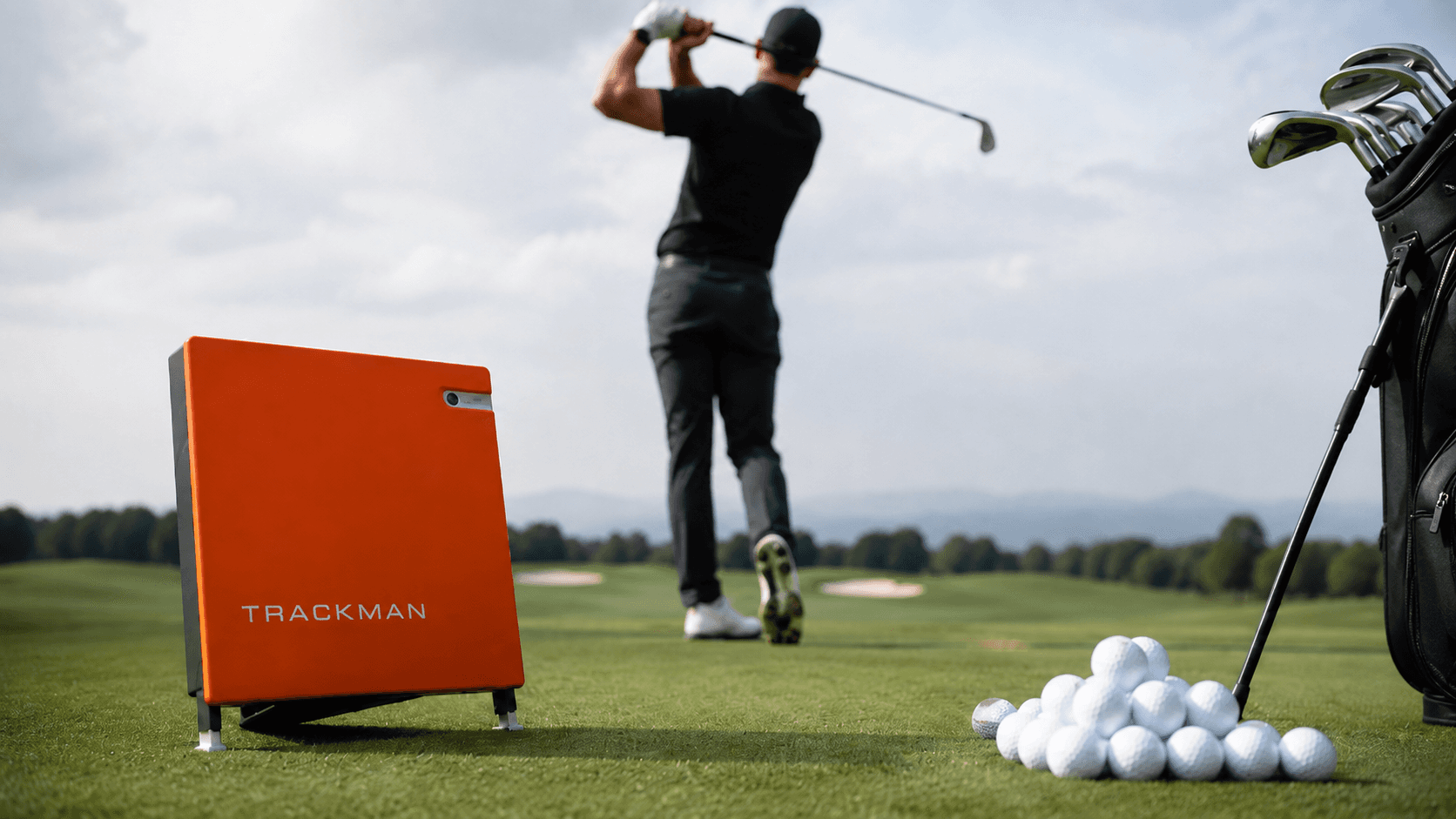
A device whose orange profile can be seen behind the backs of almost every PGA Tour player during practice sessions on the range.
Technology: Dual Radar OERT (Optically Enhanced Radar Tracking) combined with cameras. Trackman combines here a radar tracking the ball with a second radar analyzing only the club, supported by optics.
Parameters: Measures absolutely everything - over 40 parameters related to the club, the ball, or the swing itself, but also several parameters referring only to the putter. In outdoor conditions, it provides full tracking of the ball trajectory.
What makes it stand out: It is the only device that performs equally well outdoors (tracking the ball flight over 300+ meters), and in a professionally prepared studio - with adequate space and preferably Titleist RCT balls - it also provides very high indoor accuracy. The integrated TPS software is a powerful analytical tool, used by players and coaches to search for and improve even the smallest nuances in the swing. Recent updates also include many entertainment modules intended not only for adults but also for children, to promote the sport and enhance the experience beyond the technical side.
For whom: Professional coaches, elite training centers, experienced players, and people who want no compromises. In our comparison, the most expensive option.
Important: Trackman 4 - is slowly being phased out of sale for the indoor market. After adapting to the high demands of indoor golf, the company wants Trackman IO to be the product dedicated to simulators and Trackman 4 to be an outdoor device for the driving range or golf course.
Trackman iO – Optical engineering enclosed in the ceiling
A solution from the Trackman family created specifically with the problem of limited space in homes in mind. Here, ball flight range is no longer a variable that disqualifies measurement quality.
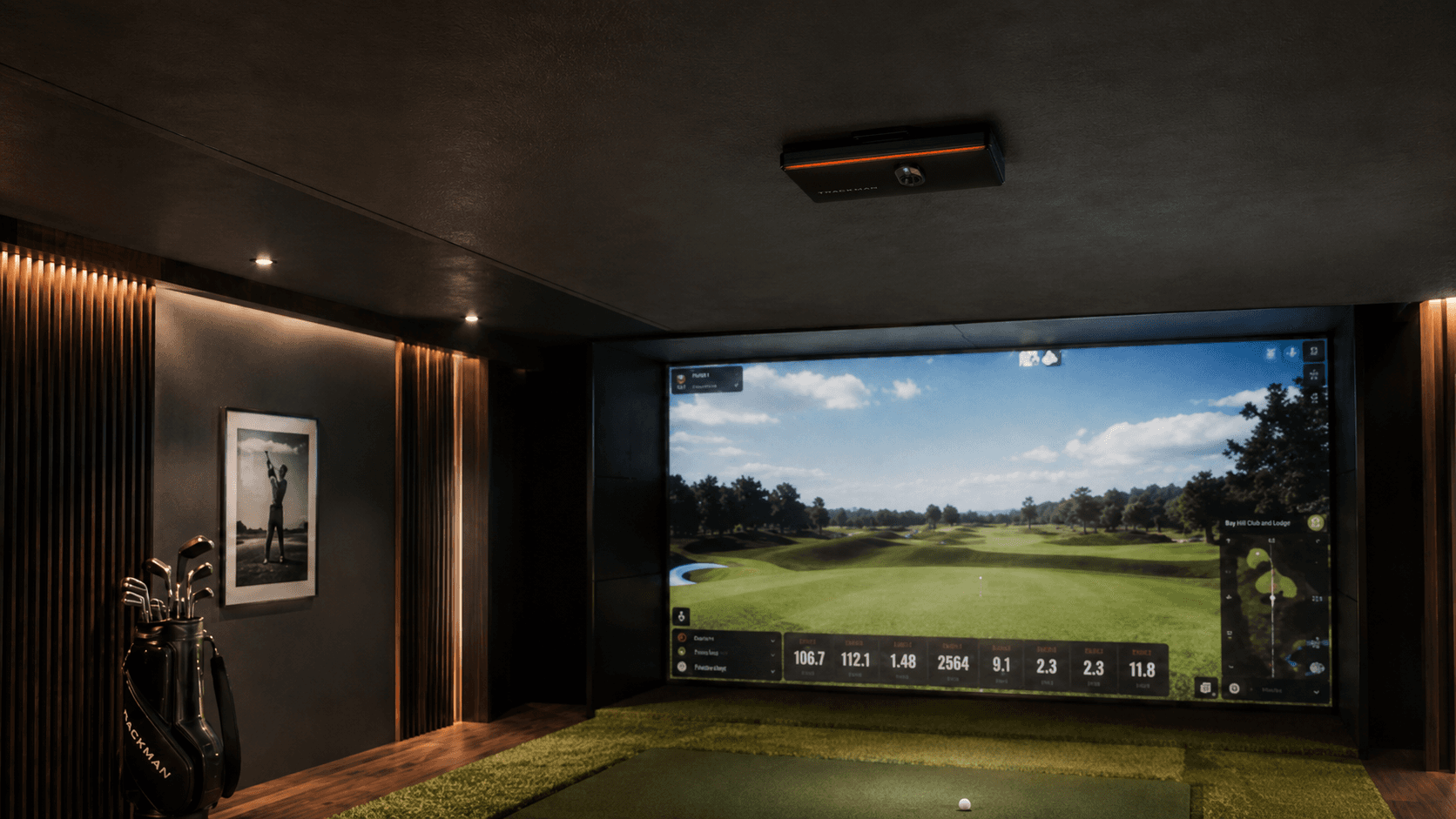
Technology: A combination of Doppler radar and ultra-fast cameras (4600 fps) mounted in a single ceiling module.
Parameters: At the time this article is being written, Trackman iO already measures practically the same set of data as Trackman 4 (over 40 parameters). The main parameter still in the testing phase is angle of attack.
What makes it stand out: No device on the floor means complete freedom for left- and right-handed players. Extremely fast data processing time (0.7s from impact to projection). The system can generate a clean recording of the impact moment without the need to use markers on the club.
For whom: For indoor installation only. Ideal for commercial simulator centers and premium home installations, where aesthetics and saving floor space are priorities. Price-wise, depending on the version (home, professional or commercial), the price is slightly lower or identical to the Trackman 4 units.
Foresight GCQuad - King of photometric precision with a touch of Doppler
GCQuad is a device that has for years been the benchmark in professional fitting and at the highest level of coaching.
Technology: Quadrascopic architecture (4 ultra-fast cameras).
Parameters: It offers a full data package, including ball speed, launch angle, spin rate/axis, and complete club data: club head speed, smash factor, AoA, club path, face angle, loft/lie at impact.
What makes it stand out: Unmatched precision in determining face impact location (the contact point on the club face). The system provides this parameter best in its class. In addition, the radar is very convenient to carry, not too heavy, and the battery lasts a very long time.
For whom: It is one of the more expensive devices in the lineup, dedicated to professional club fitters, coaches, and home simulators where photometric technology works best. Foresight also focuses on a user-friendly experience through a very well-made range module and golf-course play. It can work both indoors and outdoors.
Foresight GC3 – GCQuad precision for a fraction of the price
GC3 is Foresight's answer to market demand for professional-level accuracy without the prohibitive entry barrier.
Technology: Three-camera system (as opposed to four in the GCQuad).
Parameters: Measures 14 key parameters. You get a complete set of ball data and basic club data (club head speed, smash factor, AoA).
What makes it stand out: It guarantees almost identical photometric accuracy to its older brother, but falls short in a few areas - it does not measure face angle or impact location. An important business advantage is that in the currently available GC3 packages, club data can be unlocked without additional, high subscription fees - although the details depend on the selected version and license.
For whom: Advanced players building their own high-end simulator, expecting Foresight precision without entering the highest price bracket.
SkyTrak+ – The evolution of the budget hit
The original SkyTrak revolutionized the home simulator market. The plus version solves most of the predecessor's problems.
Technology: Photometric system (high-speed cameras) combined with Doppler technology for direct tracking of club head movement, which allows accurate measurement of parameters such as club path or face angle.
Parameters: Smooth and accurate ball data. SkyTrak+ can now measure club head speed, smash factor, AoA, path, and face angle/face-to-path, all without the need to use stickers on the face. In total, the device can measure 21 different parameters.
What makes it stand out: Fast response time (shot-to-show) below 2 seconds (in the new MAX model it is below 1 second). The system offers a 40% larger hitting zone than the first generation, which significantly improves playing comfort. It does not require specialized balls. It also has a large module for games and entertainment. Golf courses available under the appropriate subscription for players are provided, among others, by Trackman and Foresight.
For whom: Players with a medium budget, building a solid home or office simulator. Players who want to spend more time on a virtual golf course than on the driving range (although here this module is definitely more polished from a visual and usability standpoint than in the more expensive counterparts). It is one of the most affordable solutions in our comparison.
FlightScope Mevo+ – A mobile command center
Mevo+ proves that radar technology can fit in a backpack.
Technology: 3D Doppler radar combined with a camera (Fusion Tracking).
Parameters: Calculates the full ball kinematics and basic club data. With the optional Pro package (requires an additional software fee), it opens the door to advanced D-Plane analysis (face to path, dynamic loft, etc.).
What makes it stand out: Amazing portability thanks to very small dimensions and a built-in, fairly decent battery. It performs excellently outdoors, physically tracking the ball flight. To obtain precise spin rate data indoors, it requires the use of stickers or dedicated Titleist RCT balls (Radar Capture Technology).
For whom: For golfers who want to train all year round - in summer on the outdoor driving range, and in winter in a home simulator. Price-wise, it is a direct competitor to SkyTrak+, positioned in the budget/medium segment. A remarkable advantage is the ability to connect external game apps to the radar and the lack of an annual subscription.
Worth knowing: most radars nowadays are based on paid annual subscriptions. Therefore, when choosing your device, it is worth checking not only the purchase price of the radar, but also the later cost of operation/use. Some companies also offer the option (besides the software license) of paying for a hardware license.
Analytical summary
To make it easier to make the final decision, we have prepared a simplified comparison matrix:
Model | Architecture | Accuracy (Segment) | Club Analysis (Club Data) | Operating environment | Price positioning |
Trackman 4 | Dual Radar + Camera | Tour-Level (Gold Std) | Full | New company policy - Outdoor only | Premium |
Trackman iO | Dual Radar + Cameras (Ceiling) | Tour-Level | Full (with video analysis) | Indoor only | Premium |
Foresight GCQuad | 4 cameras (photometry + IR) | Tour-Level | Full (including Impact Location) | Indoor / Outdoor | Premium |
Foresight GC3 | 3 Cameras | High / Tour | Basic (without Face Angle) | Indoor / Outdoor less recommended | Medium |
SkyTrak+ | Camera + Doppler | Good / High | Basic (without markers) | Indoor / Outdoor less recommended | Budget / Medium |
FlightScope Mevo+ | Doppler + Camera | Good / High | Extended (requires Pro package) | Indoor / Outdoor | Budget / Medium |
Decision architecture: Which system is right for you?
Choosing the right launch monitor should not be based solely on budget, but on a precise definition of your training, entertainment, and space-related needs.
Looking for an uncompromising indoor simulator (Premium segment).
If you are building a luxury area at home or in an office or commercial facility and you care about a floor freed from electronics, instant video feedback, and access to more than 40 different measurable swing parameters – Trackman iO will be the best choice. If you prefer a stand-alone device that is a bit cheaper and will also show most aspects of your swing with high precision – choose GCQuad.
In this segment, of course, there is also Trackman 4 - but as we noted earlier, this is a radar that Trackman will not sell for indoor simulators.
I am a coach / Looking for equipment for professional fitting and teaching (Premium segment)
You need the full data package, including rigorous analysis of club head work. Here the battle is between Trackman 4 (brilliant outdoor performance, powerful TPS software) and GCQuad (king of optical precision, unmatched for the short game and putting).
I want to train with full data, but my budget has limits (Medium segment)
Foresight GC3 is the ideal compromise. You get tour-level accuracy in ball reading with a minimal margin of error, giving up only the most advanced club parameters. A huge plus is the lack of hidden subscriptions for access to data. Also in this segment we will highlight the Sktyrak+ radar (or the latest SkyTrak MAX model - improved radar architecture in terms of precision and speed). The latest software and access to premium courses together with the connection, with the long-awaited Doppler module, gives you the feel of the Medium segment for a very reasonable price. The SkyTrak+ radar is not suitable for playing from turf at the driving range. The place where the ball must be set is shown by laser, which can be troublesome in strong sunlight - these features may disqualify it for many players.
I am starting to build a home simulator / Looking for portable equipment (Budget segment)
If mobility and play on an outdoor range matter to you – Mevo+ will give you excellent results (remember the stickers and RCT balls). In this case, SkyTrak+ will also work. It is still a budget solution, but with Medium-segment qualities. The SkyTrak+ radar works best primarily in the indoor version, providing you with accurate, smooth simulation without the need for special balls.
Investing in swing architecture
Technology is today the only way to objectively diagnose your mistakes. A shot that "felt good," when compared with radar readings, often exposes a terrible smash factor or a dangerous attack angle. Understanding the numbers you generate is the fastest path to steadily lowering your handicap.


Level up your game
Let's meet
Design office:
1 Górnośląska St.,
00-443 Warsaw
Showroom:
Golf green - book an appointment
Chabrowa 2 St.,
62-053 Borkowice
Write
Email address