
Maintaining golf fitness in winter: 5 ways for effective training at home
The key is a smart, home plan: not random swinging of a club in the living room, but five specific pillars of training that you can implement within your own four walls – with a professional simulator or with minimal equipment.
1. Home putting training – 15 minutes to lower your score
It's simple math: putting accounts for 40% of your score, and requires the least space for training. 15 minutes a day on the carpet yields better results than hours spent at a driving range. At home, you work in laboratory conditions – eliminating wind and unevenness, focusing on two variables: ideal contact and a repeatable path (start line). This is where you "purchase" yourself a lower handicap for the upcoming season.
It's worth focusing on a few proven exercises:
Ladder drill – set points every 50–100 cm and try to stop the ball in designated zones. This teaches you pace, not just aim.
Clock drill – putt to a target from different sides (like the hours on a clock) to train routine and aiming from various angles.
Putt on a ruler – hitting the ball along a narrow strip (e.g., yard stick) is a ruthless test: if the ball drops, the clubface (face) was not perpendicular to the line at impact.
2. Chipping and wedge: Technique over distance
In winter, you can't recreate a 30-meter lob over a bunker in your living room, but you can refine your short game mechanics. Indoor training is about contact, balance, and a simple, repeatable technique. It's crucial to understand how slight shifts in the ball's position in your stance change its flight:
Ball by the left ankle: Higher trajectory and more loft.
Ball under the bridge: Neutral trajectory, optimal for most shots.
Ball closer to the right leg: A low, rolling chip type bump and run.
During training, ensure that 70–80% of your body weight is on the lead leg. This stabilizes the bottom of the swing and eliminates the risk of chunk shots (hitting the ground before the ball).
3. Dry swing training: Mirror and rhythm
Winter removes the pressure of "where did the ball go". This is the perfect time for "dry" practice. Use a mirror to verify the geometry of your swing: spine angles and club plane. But technique is not everything – the key is rhythm.
Apply the Tour Pro biomechanics rules: Rhythm 3:1. Three units of time to load energy (backswing) and one to release it (downswing). Practicing with a metronome at home embeds muscle memory that will work automatically in the spring.
4. Golf gym: Mobility, strength, and core
The off-season is the only time of the year to work on physiology. Programs like Fit For Golf confirm: mobility and strength translate to better repeatability, spine safety, and additional yards off the tee.
The table below presents a basic routine you can perform at home:
Pillar | Example exercise | Repetitions | Main goal |
Mobility | 90/90 hip rotations | 2 x 45 sec. | Hip rotation range |
Strength | Goblet squat / Lunges | 3 x 8-10 | Lower body strength |
Core | Pallof press / Plank | 3 x 12 / 40s | Spine protection |
Power | Medicine ball throws | 3 x 6 | Clubhead speed |
5. Simulator: Your private, year-round fairway
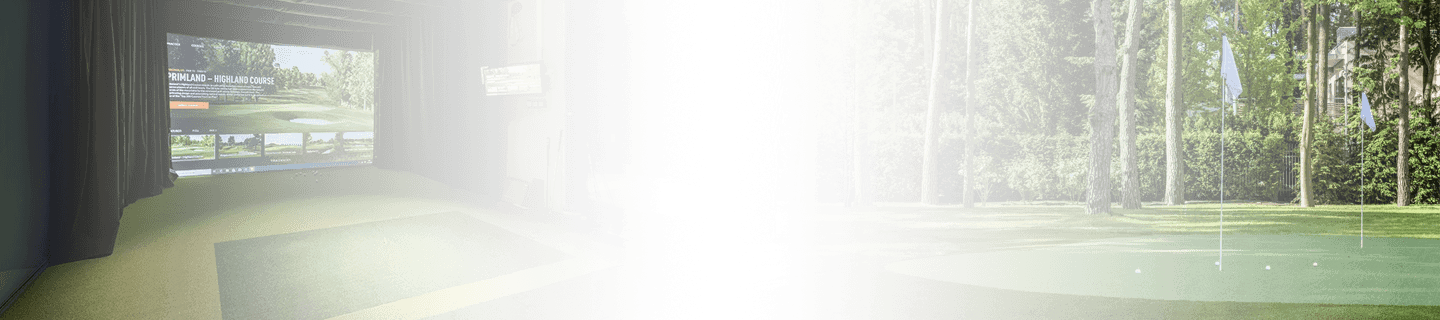
This is the element that ties all the above points together. In theory, you can survive the winter on a mat and foam balls, but if you take the game seriously, the simulator is an indispensable tool. It allows you to train your full game – from driver to course strategy – in a warm, controlled environment.
The greatest advantage of the simulator is access to hard data. Putting or chipping drills gain a new quality when the system shows you the real trajectory, spin, and launch angle. You stop guessing based on "feel", and start accurately verifying your progress. Moreover, indoor training is at a stable temperature: your muscles are more flexible, which drastically reduces the risk of winter injuries.
How to implement this in life? Your weekly plan
To step onto the course in the spring with full confidence, propose a simple training skeleton:
2 times a week (technical training): 15 min of putting, 20 min of chipping, and 15 min of working in front of the mirror.
2-3 times a week (fitness): 30-40 minutes of mobility and strength exercises according to the above table.
1 time a week (golf session): If you have access to a simulator, play 9 holes or do accuracy training on the range (e.g., wedge distances).
Winter doesn't have to be a break from golf. It can be the foundation for your lowest handicap in the upcoming season.



Level up your game
Let's meet
Design office:
1 Górnośląska St.,
00-443 Warsaw
Showroom:
Golf green - book an appointment
Chabrowa 2 St.,
62-053 Borkowice
Write
Email address